
Enterprise Onboarding Experience
The onboarding wasn't broken. The inbox was.
Role: UX Research & Design
Timeline: 1 Months
Team: UX Designers, Researchers, HR
Overview
A Fortune 100 global consulting firm onboards thousands of new hires every year. The infrastructure existed. The training content existed. The problem was that new hires couldn't find any of it because their inboxes were already buried under dozens of daily company-wide emails before they'd completed a single training module. I joined the team to map the end-to-end experience, synthesize research findings, and brainstorm possible solutions. The intervention we landed on was a systems-level decision: protect the inbox during the onboarding window by preventing new hire emails from being added to distribution lists until after training completion.
Problem
New hires at the client organization were struggling to complete onboarding not because the content was bad, but because the delivery system was working against them. From day one, their inboxes were flooded with company-wide announcements, team newsletters, and department updates. Critical onboarding links and training walkthroughs were buried within days.
The cognitive load was immediate and overwhelming. New hires were spending their first weeks managing noise instead of building competency.
Research & Process
Experience Mapping
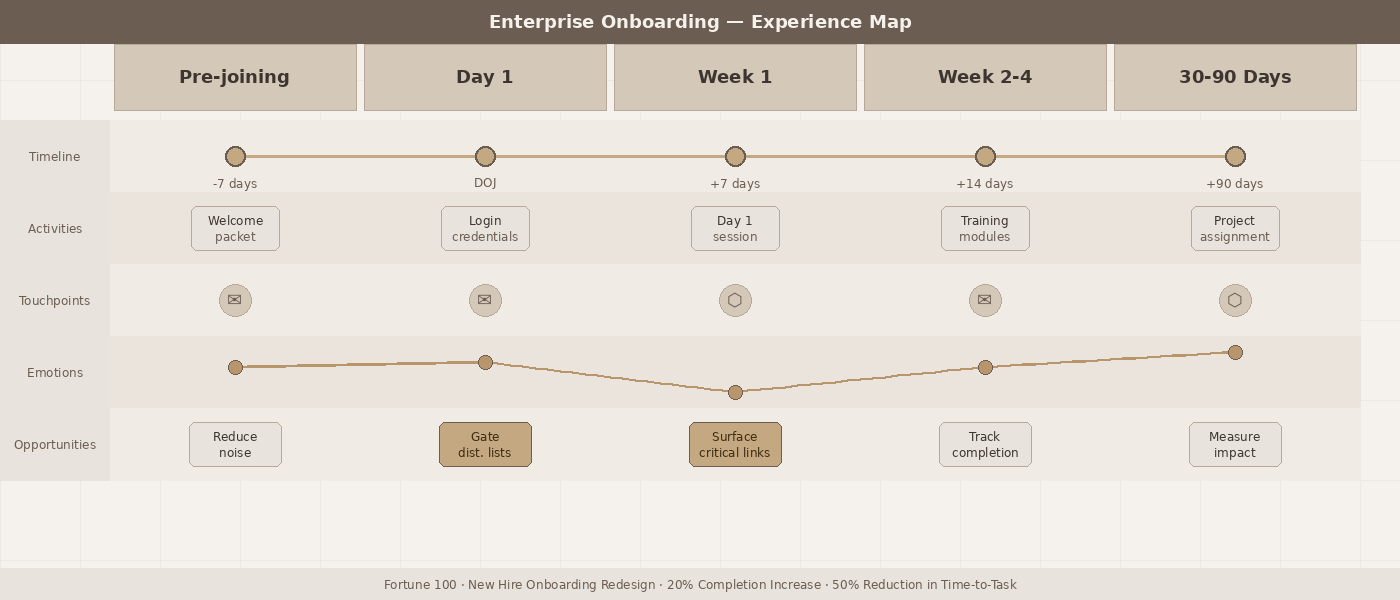
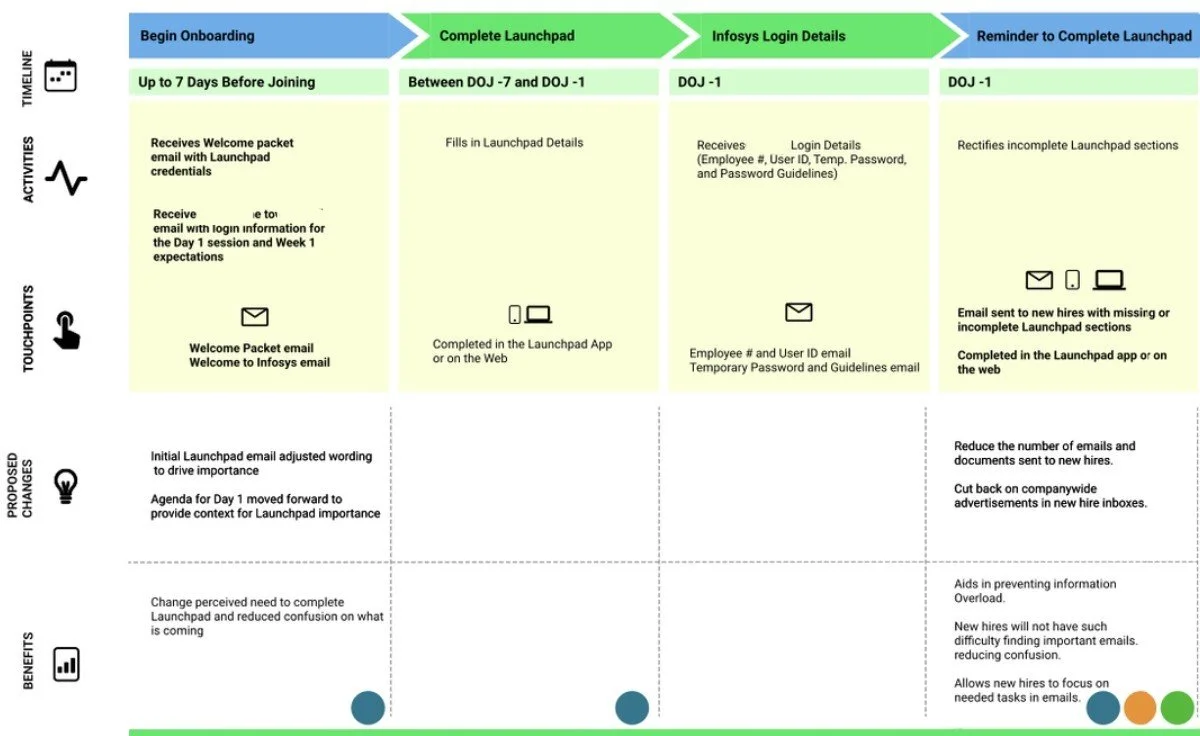
My primary contribution was helping map the end-to-end new hire journey from offer acceptance through the first 90 days. The as-is map revealed exactly where the experience broke down: not at onboarding itself, but in the days immediately following, when the inbox became unmanageable and critical links became unfindable.
Research Synthesis
Working alongside my team, I synthesized qualitative feedback from new hires and HR stakeholders to identify recurring patterns. The data pointed consistently to one failure mode: the signal-to-noise ratio in the inbox collapsed within the first week and never recovered.
Ideation
I contributed several solution directions during brainstorming, including the distribution list filter concept gating new hire email discoverability until after training completion. This wasn't a new tool. It was a smarter use of what already existed.
Key insights: The problem wasn't information overload. It was that all information was treated as equally urgent.
New hires weren't failing because they lacked motivation or the content wasn't there. They were failing because no one had protected their attention during the most critical window of their employment.
Solution
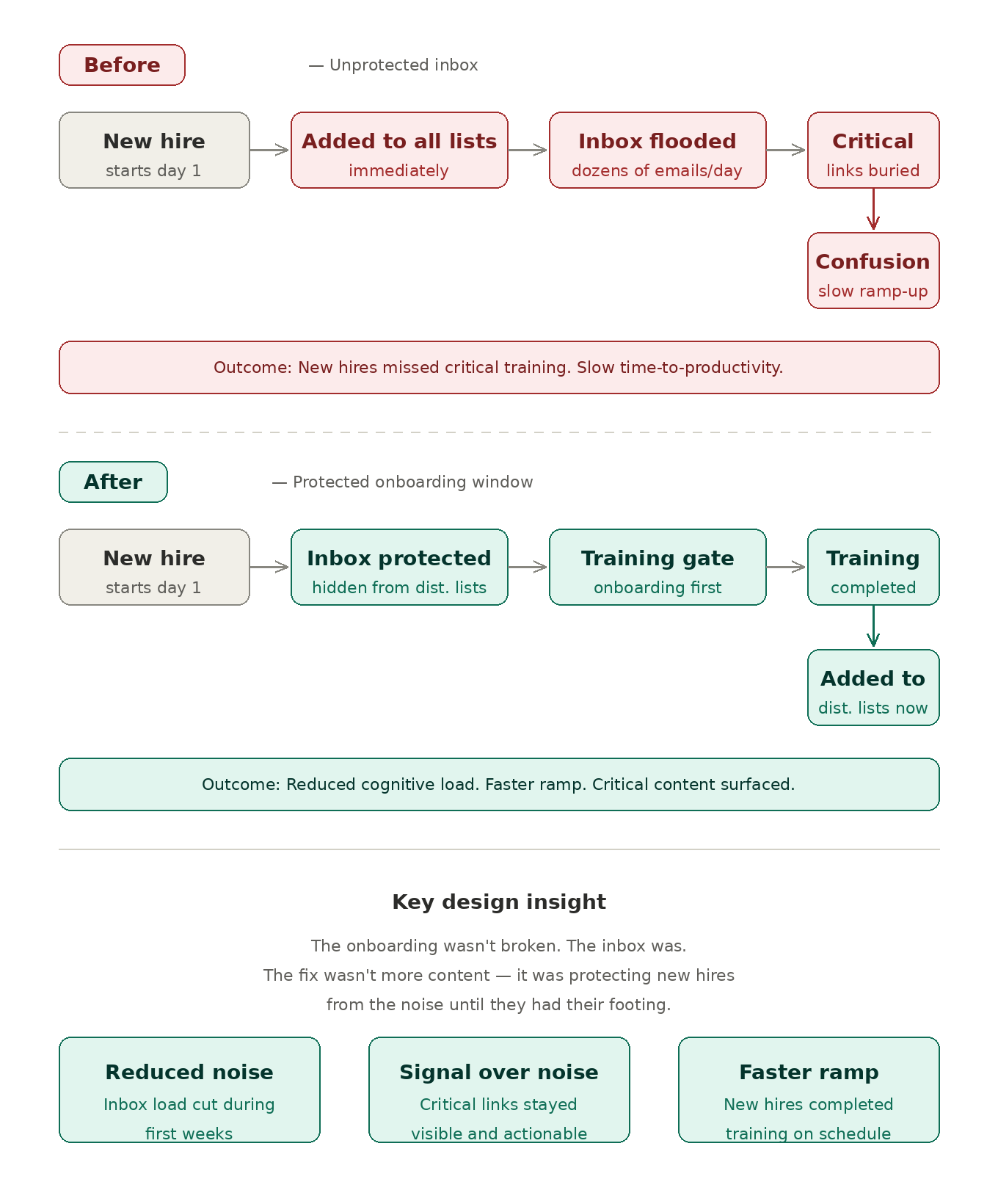
We redesigned the onboarding flow around a protected window. New hire email addresses were withheld from company-wide distribution lists and announcement tags until they completed their initial training sequence. Their inboxes stayed quiet and purposeful during the weeks that mattered most surfacing only the content relevant to their onboarding.
The fix required no new platform. No new content. Just a deliberate systems decision about when to introduce noise.
Impact
Client HR provided post-launch metrics that validated the intervention directly:
20% increase in onboarding completion rate
50% reduction in time-to-task for new hire training milestones
These weren't incremental improvements. They were the result of removing friction from a system that had been working against its own users.
Reflection
This project taught me that the most impactful design decisions aren't always visible ones. We didn't redesign a single screen. We redesigned a policy and the numbers moved more than any UI change likely would have.
It also reinforced the value of experience mapping as a diagnostic tool. The journey map didn't just show us where things went wrong. It showed us why and that distinction pointed directly to the solution. Sometimes the design work is understanding the system well enough to know which lever to pull.